







<back
High-Reliability Nuclear Grade Connector: Why 1E-Level Environments Demand Rapid and Secure Connections
Nuclear power facilities depend on reliable electrical connections to support monitoring, control, communication, and other essential equipment. In these demanding applications, connectors must maintain stable electrical contact while meeting strict mechanical and environmental requirements. A high-reliability nuclear-grade connector is designed for applications where connection security, operational consistency, and environmental compatibility are particularly important. Especially in 1E-level environments, the connector's structural design and applicable qualification requirements play an important role in supporting dependable electrical systems.
Why Do 1E-Level Environments Require Reliable Connectors?
Nuclear power plants operate with different equipment classifications and environmental conditions. In particular, Class 1E electrical equipment is associated with nuclear safety-related functions, so its supporting components must meet applicable technical and qualification requirements. Connectors used in these environments need to maintain their intended electrical and mechanical functions under specified operating conditions. Therefore, selecting a suitable nuclear energy connector requires careful consideration of its design, material characteristics, connection structure, and compliance documentation.
Moreover, nuclear facilities may contain equipment exposed to challenging conditions, including vibration, temperature variations, moisture, and other environmental stresses. The actual requirements depend on the installation location and the equipment's assigned classification. Consequently, a connector for harsh environment applications should be evaluated against the conditions it will encounter rather than selected solely by its external appearance or general product category. This approach helps engineers match connector performance with the technical requirements of the intended system.
How Do Rapid Connection and Secure Locking Improve Reliability?
Connection speed is an important consideration when electrical equipment requires installation, inspection, or replacement. However, rapid mating must also provide a secure mechanical connection to prevent unintended disconnection during normal operation. A well-designed locking structure helps maintain the connection between the plug and socket while allowing technicians to perform mating and unmating operations efficiently. As a result, a high-reliability nuclear-grade connector can support practical installation and maintenance requirements without overlooking connection security.
In addition, the locking mechanism should be compatible with the equipment's mechanical arrangement and operating conditions. A secure connection helps reduce the risk of loose mating interfaces, which could otherwise affect electrical continuity or equipment operation. At the same time, technicians should follow the specified installation and inspection procedures to confirm that each connection is properly engaged. These considerations become particularly important in nuclear facilities, where equipment reliability depends on both component quality and correct system integration.
The Role of MIL-DTL-38999 Connector Standards
Military circular connector standards provide important technical references for connector design, construction, and performance requirements. The MIL-DTL-38999 connector family is widely associated with demanding electrical and mechanical applications, including aerospace, defense, and other harsh operating environments. For nuclear power applications, however, engineers must verify the exact standard edition, product configuration, and qualification documentation required by the project. Meeting a particular connector standard should not automatically be interpreted as proof of qualification for every nuclear installation.
The connector series introduced by Airoadcon is independently developed, designed, and manufactured to comply with the technical requirements of the GJB599A series, identified in the supplied product information as MIL-DTL-38999K. This provides a defined technical basis for evaluating the product in relevant applications. Nevertheless, project teams should review the applicable documentation and confirm whether additional nuclear industry qualification or environmental testing is required. Such verification helps ensure that the selected connector meets the actual requirements of the equipment and installation location.
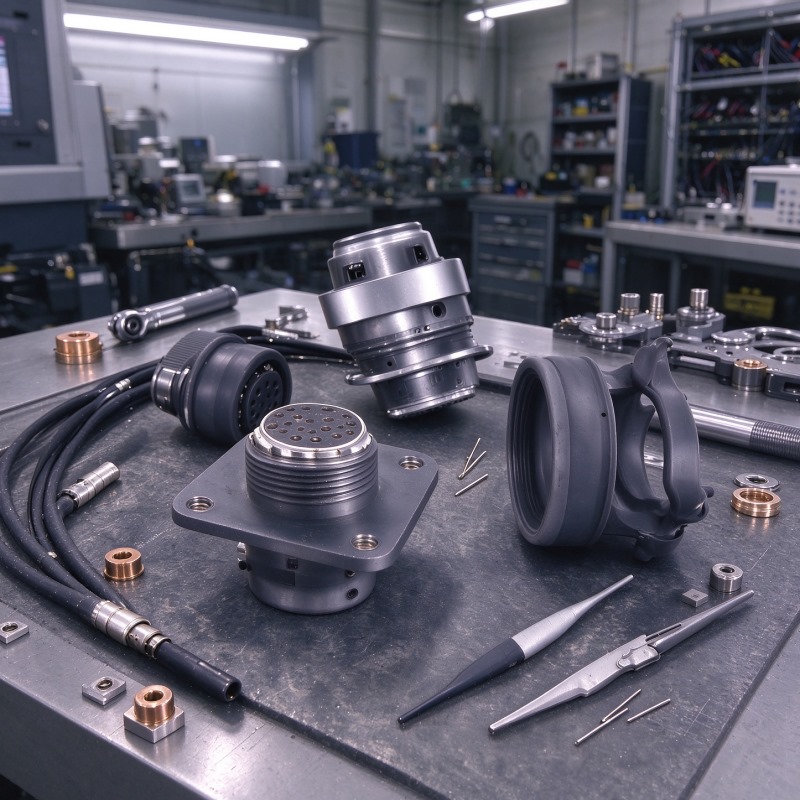
What Should Engineers Consider in Nuclear Connector Selection?
Choosing a connector for nuclear reactor systems involves more than checking its mechanical dimensions or connection method. Engineers should first identify the electrical requirements, including operating voltage, current capacity, contact configuration, and insulation characteristics. They should also evaluate environmental conditions, mounting arrangements, cable compatibility, and the required service life. For example, a high-voltage connector must have electrical ratings and insulation performance appropriate for its intended circuit rather than relying on its general industrial or military-style construction.
Furthermore, environmental qualification should match the specific location where the connector will operate. Normal operating areas and 1E-level harsh environments may involve different qualification requirements, so the same connector configuration should not be assumed suitable for every installation. Documentation covering relevant testing, materials, and manufacturing controls can help engineers assess whether a product meets project specifications. Therefore, early communication between equipment manufacturers, connector suppliers, and engineering teams can reduce compatibility issues during system integration.
Applications in Nuclear Power and Other Demanding Industries
Nuclear power facilities use electrical connectors in various equipment assemblies that support monitoring, control, instrumentation, and power-related functions. In these applications, a high-reliability nuclear-grade connector can provide a practical connection solution when its technical characteristics match the equipment's requirements. Its rapid connection and disconnection capabilities may also simplify certain installation and maintenance operations. However, final suitability must always be determined through the relevant engineering assessment and qualification process.
Beyond nuclear power, connector designs developed for demanding environments may also be considered in industrial control, aerospace, defense, and other specialized equipment. These applications often require secure mating, consistent electrical contact, and compatibility with challenging operating conditions. Nevertheless, each industry has its own standards and qualification procedures, so users should verify the applicable requirements before adopting a connector across different systems. This is particularly important when the connector is intended for safety-related or mission-critical equipment.
How Does Connector Manufacturing Support Long-Term Performance?
Manufacturing consistency is essential when connectors are used in equipment that requires dependable electrical connections. Material selection, contact processing, dimensional control, assembly procedures, and inspection can all influence the final product's mechanical and electrical characteristics. In addition, traceable production records and appropriate testing procedures help customers evaluate product consistency. These manufacturing considerations are especially relevant when a connector is intended for use in regulated or safety-related industries.
Airoadcon develops and manufactures its connector series with the aim of meeting the technical requirements of demanding applications. For nuclear power projects, customers should provide the intended operating environment, electrical specifications, mechanical interface, and applicable qualification requirements during the selection process. This allows the connector configuration and supporting documentation to be reviewed against the actual project needs. Ultimately, a high-reliability nuclear-grade connector must combine secure connection performance with verified technical suitability to support dependable operation in its intended environment.