







<back
Rugged Military Bayonet Circular Connector: How Quick-Lock Mechanisms Ensure Secure Mating Under Vibration
Military and aerospace electronic systems often operate in environments where vibration, mechanical shock, and limited installation space can affect electrical connections. Therefore, connectors must provide reliable mating and stable contact even when equipment experiences continuous movement. A rugged military bayonet circular connector uses a quick-lock mechanism to establish a secure connection while allowing fast mating and unmating. This design is particularly useful for portable communication equipment, avionics, radar systems, and other applications that require dependable electrical connectivity.
Why Does Vibration Resistance Matter in Military Connectors?
Military equipment frequently operates in vehicles, aircraft, ships, and field environments where mechanical vibration is difficult to avoid. Continuous movement can place stress on connector interfaces and may cause conventional locking structures to loosen over time. If the mating connection becomes unstable, electrical interruptions or signal transmission problems may occur. Consequently, connector locking performance is an important consideration in mission-critical electronic systems.
A reliable military circular connector should maintain stable mechanical engagement while protecting its contact interface. Its housing, coupling structure, contact arrangement, and termination design all contribute to overall connection reliability. In addition, the connector must match the equipment's electrical requirements and environmental conditions. For this reason, engineers should evaluate both mechanical retention and electrical performance when selecting a connector.
How Does a Bayonet Quick-Lock Mechanism Work?
A bayonet locking mechanism uses a guided engagement structure that allows two connector halves to mate through a short rotational movement. Instead of requiring multiple turns like some threaded coupling designs, the user aligns the connector components, inserts them, and rotates the coupling section until the locking position is reached. This makes installation and removal faster, especially when equipment requires frequent connection changes. Furthermore, the positive locking action helps maintain mechanical engagement during normal vibration and movement.
For a rugged military bayonet circular connector, the locking structure is designed to provide a secure mating interface without making operation unnecessarily complicated. The mechanism helps reduce the risk of accidental separation when the connector is correctly assembled and compatible with the application. However, actual vibration resistance also depends on connector construction, contact retention, cable support, installation quality, and the vibration conditions involved. Therefore, the locking mechanism should be evaluated as part of the complete connector assembly rather than as an isolated feature.
Key Design Features That Support Secure Connections
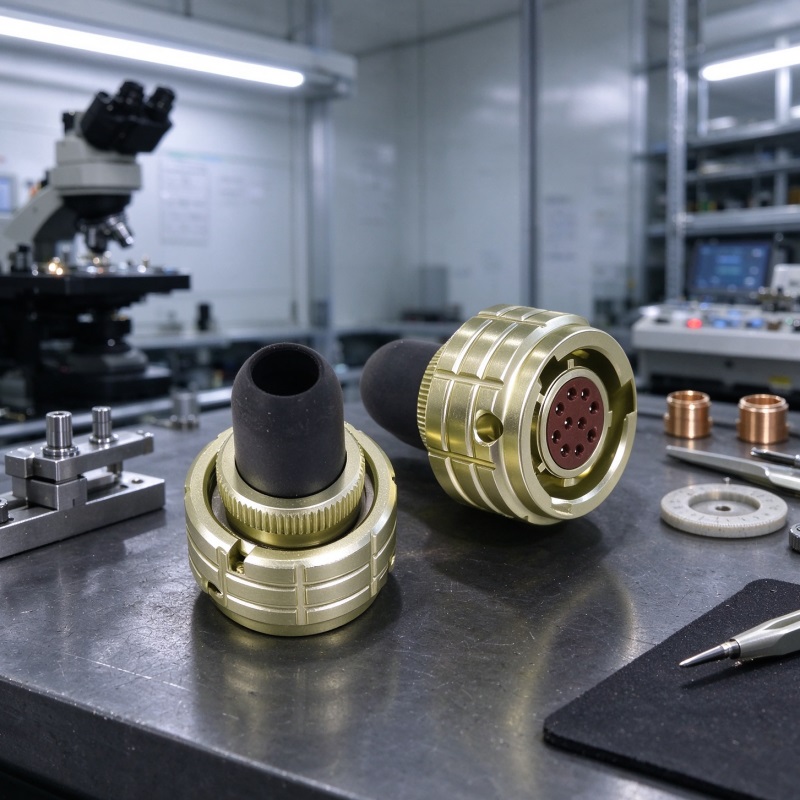
Connector reliability depends on several structural features working together. The OHS Series ultra-compact bayonet circular connector combines a space-saving design with a quick-lock coupling structure for applications where installation space and connection security are both important. Moreover, its available configurations allow engineers to consider different contact arrangements, housing materials, and termination requirements.
Contact plating is another important consideration because it can influence electrical contact performance and resistance to environmental exposure. Gold-plated and silver-plated contacts are available as configuration options, allowing buyers to select suitable finishes according to their project requirements. In addition, shielded tail options can support applications where electromagnetic interference needs to be considered. Together, these design choices help engineers integrate connectors into compact and demanding electronic systems.
Bayonet Connectors Compared with Other Coupling Designs
Different circular connector coupling mechanisms offer different advantages depending on installation conditions and operating requirements. Bayonet coupling is often preferred when fast connection and disconnection are important, while threaded designs may be suitable for applications requiring a different coupling arrangement. Push-pull structures can also provide convenient operation in compact equipment. Therefore, the best option depends on the required balance between installation speed, mechanical retention, and application conditions.
A bayonet design can be especially practical when operators need to connect equipment quickly under field conditions. Unlike threaded coupling, which requires rotating a coupling nut through multiple turns, bayonet coupling uses a shorter rotational movement to reach its locking position. However, this does not mean that one design is universally better than another. Engineers should also consider connector size, cable loading, environmental exposure, and the retention performance required by the equipment.
Applications in Defense, Aerospace, and Industrial Systems
A rugged military bayonet circular connector can support a range of electronic systems that require compact construction and reliable mechanical coupling. In defense applications, it may be used in portable communication devices, radar equipment, weapon control units, and field-deployed electronics. These systems often require connectors that are easy to operate while maintaining stable engagement during movement. Consequently, bayonet coupling can be a practical option for equipment that undergoes frequent connection changes or operates in demanding field conditions.
In aerospace and avionics, compact circular connectors can be integrated into navigation equipment, onboard electronics, satellite systems, and airborne test instruments. Similarly, industrial and specialized equipment used in oil and gas exploration, marine electronics, and automation may require connectors designed for demanding operating environments. In high-density installations, the ultra-compact OHS Series design can help engineers manage limited space while maintaining the required connection layout.
How to Select a Connector for Harsh Environments
Selecting a connector for harsh environment applications requires a review of both electrical and mechanical requirements. Buyers should not rely only on the product category or locking mechanism because actual performance depends on the complete configuration and applicable test standards. In particular, military projects may specify requirements for vibration, shock, temperature, moisture, corrosion, and electromagnetic compatibility. Therefore, reviewing the technical documentation is essential before choosing a connector.
Engineers should first confirm the required pin count, contact arrangement, housing material, and termination style. They should then evaluate whether gold or silver contact plating is suitable for the electrical and environmental conditions. Furthermore, the selected model should be checked against the project's specified vibration, shock, temperature, and moisture requirements. Buyers should also verify the exact military specification and model documentation rather than assuming that every circular connector automatically meets the same MIL-SPEC requirements.
Custom OHS Series Connector Solutions
Different military and industrial systems may require specific pin layouts, contact plating, housing materials, and termination configurations. Airoadcon provides OHS Series circular connector options with OEM/ODM customization to support project-specific requirements. In addition, bulk supply, quality control, and global shipping services can help customers coordinate connector procurement for ongoing production and specialized equipment projects.
Before placing an order, buyers should confirm the exact model, including the OHS-BC14/10P21B configuration, together with its pin arrangement and termination details. They should also review the applicable technical documentation, inspection requirements, and environmental test results. This process helps ensure that the selected connector matches the intended equipment and operating conditions.
Conclusion
Reliable electrical connections in military and aerospace equipment depend on suitable coupling structures, contact configurations, and environmental compatibility. Bayonet quick-lock mechanisms provide fast mating and positive engagement, making them useful for applications where installation efficiency and connection security are important. By combining compact construction with appropriate contact and housing options, rugged military bayonet circular connector designs can support demanding electronic systems under vibration and movement. Ultimately, selecting the right connector requires checking the complete technical specifications and verifying its suitability for the intended operating environment.